The Hidden Danger of DIY Maintenance
Every homeowner wants to save a few dollars. When you see a dryer vent kit at a local hardware store, it looks like a simple, powerful solution to a nagging chore. You think, “I can do this myself.” However, there is a massive difference between moving lint around and actually removing it.
At Always A Sweep, we’ve seen the aftermath of “successful” DIY cleanings that ended in disaster. A dryer vent kit often provides a false sense of security while leaving behind highly flammable debris in areas you can’t see. In this guide, we will explore the essential reasons why professional intervention isn’t just a luxury, it’s a safety necessity.
Why a Standard Dryer Vent Kit Falls Short
A typical dryer vent kit usually consists of a few flexible rods and a nylon brush. While these are okay for a 3-foot straight pipe leading directly outside, modern homes are rarely built that way.
The Durability Gap
Retail kits are often made of inferior plastics. If a rod snaps inside your wall while attached to a drill, you have transitioned from a routine cleaning to a major home repair. Professional technicians use high-grade, industrial-strength equipment that is designed to withstand the torque and heat of deep-cleaning long vent runs.
Lack of Diagnostic Capability
A dryer vent kit is a blind tool. It cannot tell you if your ducting is disconnected, crushed, or if a family of rodents has chewed through the line. Without the expertise and specialized cameras used by Always A Sweep, you are essentially “cleaning in the dark”.
The 5 Critical Spots Your Dryer Vent Kit Can’t Reach
1. The Internal Heating Element Cabinet
The most dangerous spot is one the dryer vent kit can’t even enter. Fine lint particles often bypass the lint trap and settle inside the dryer’s internal cabinet, right next to the heating element.
- The Risk: When the heating element glows, this “dust bunny” environment can ignite instantly.
- The Pro Advantage: Professionals disassemble the dryer casing to vacuum out the internal motor and heating areas.
2. Multi-Directional 90-Degree Elbows
Most vents travel through floors and walls, requiring several 90-degree turns. A DIY dryer vent kit brush often gets stuck in these corners. Instead of pulling lint out, the brush frequently compacts the lint into a “plug” at the corner, further restricting airflow.
3. Vertical Roof Terminations
If your vent exits through the roof, a dryer vent kit is virtually useless.
- Gravity: Lint is heavy. When it moves upward, it naturally wants to fall back down.
- The Roof Cap: Most roof caps have a “damper” or screen that catches lint. To clean this, you must be on the roof with specialized tools.
4. Transition Ducting Behind the Wall
Many homes use “foil” or “plastic” transition ducts behind the wall, which are actually fire hazards. A DIY dryer vent kit can easily puncture these thin materials. Always A Sweep inspects these transitions to ensure they meet modern building codes (UL 2158A).
5. Exterior Pest Guards
Birds and squirrels love the warmth of a dryer vent. They build nests that are packed tight with mud and twigs. A nylon brush from a dryer vent kit isn’t strong enough to dislodge a bird’s nest; it usually just pushes the nest deeper into the pipe.
The Science of Airflow: Why DIY Can Make Things Worse
To understand why your dryer vent kit might be failing, we have to look at fluid dynamics. Dryers rely on a specific volume of air, measured in Cubic Feet per Minute (CFM), to carry moisture away.
When you use a cheap dryer vent kit, you often leave “ridges” of lint along the walls of the pipe. This increases friction and turbulence, which drastically reduces the velocity of the air. This causes your dryer to run hotter and longer, significantly shortening the lifespan of your appliance and increasing your energy bill by up to 30%.
Why Always A Sweep is the Authoritative Choice
EEAT guidelines prioritize content that shows real-world experience. At Always A Sweep, we don’t just write about vents; we live them.
- Experience: Our technicians have encountered every vent configuration imaginable, from historic homes to modern high-rises.
- Expertise: We understand the NFPA 211 standards and local building codes.
- Authoritativeness: We are recognized leaders in the chimney and venting industry, often cited for our commitment to fire prevention.
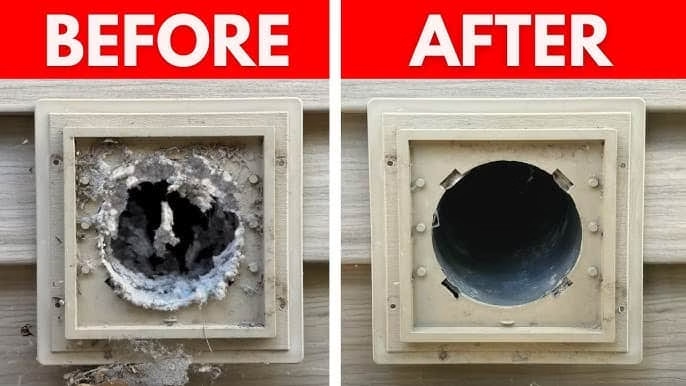
- Trustworthiness: We provide transparent reporting, including “before and after” photos and video inspections.
Professional Note: We strongly discourage DIY cleaning for any vent run longer than 10 feet. The risks of pipe damage and fire far outweigh the $50 saved on a retail kit.
Professional vs. DIY: A Cost-Benefit Analysis
| Metric | DIY Dryer Vent Kit | Always A Sweep Professional |
| Initial Cost | $30 – $50 | Competitive Service Fee |
| Time Investment | 2-4 Hours (Plus cleanup) | 1 Hour (We do it all) |
| Risk of Damage | High (Broken rods/punctured ducts) | Zero (Insured & Guaranteed) |
| Effectiveness | 40% – 60% of lint removed | 99% of lint removed |
| Safety Tools | Plastic Brush | Compressed Air, HEPA Vac, Cameras |
The Environmental Impact of a Clogged Vent
Beyond fire safety, a clogged vent is an environmental nightmare. If your dryer has to run twice for one load of towels because your dryer vent kit didn’t clear the line, you are wasting gallons of water (if using a steam cycle) and massive amounts of electricity or gas.
By hiring a professional, you ensure your appliance operates at peak efficiency, reducing your carbon footprint and saving you hundreds of dollars annually in utility costs. This is part of our commitment to sustainable home maintenance.
Conclusion: Prioritizing Your Home’s Safety
A dryer vent kit is a tool for maintenance, but it is not a tool for safety. The hidden spots, the elbows, the roof exits, and the internal machinery, require a level of precision that only a professional can provide.
Don’t wait for a “Check Vent” light or a burning smell to take action. Protect your investment, your home, and most importantly, your family.